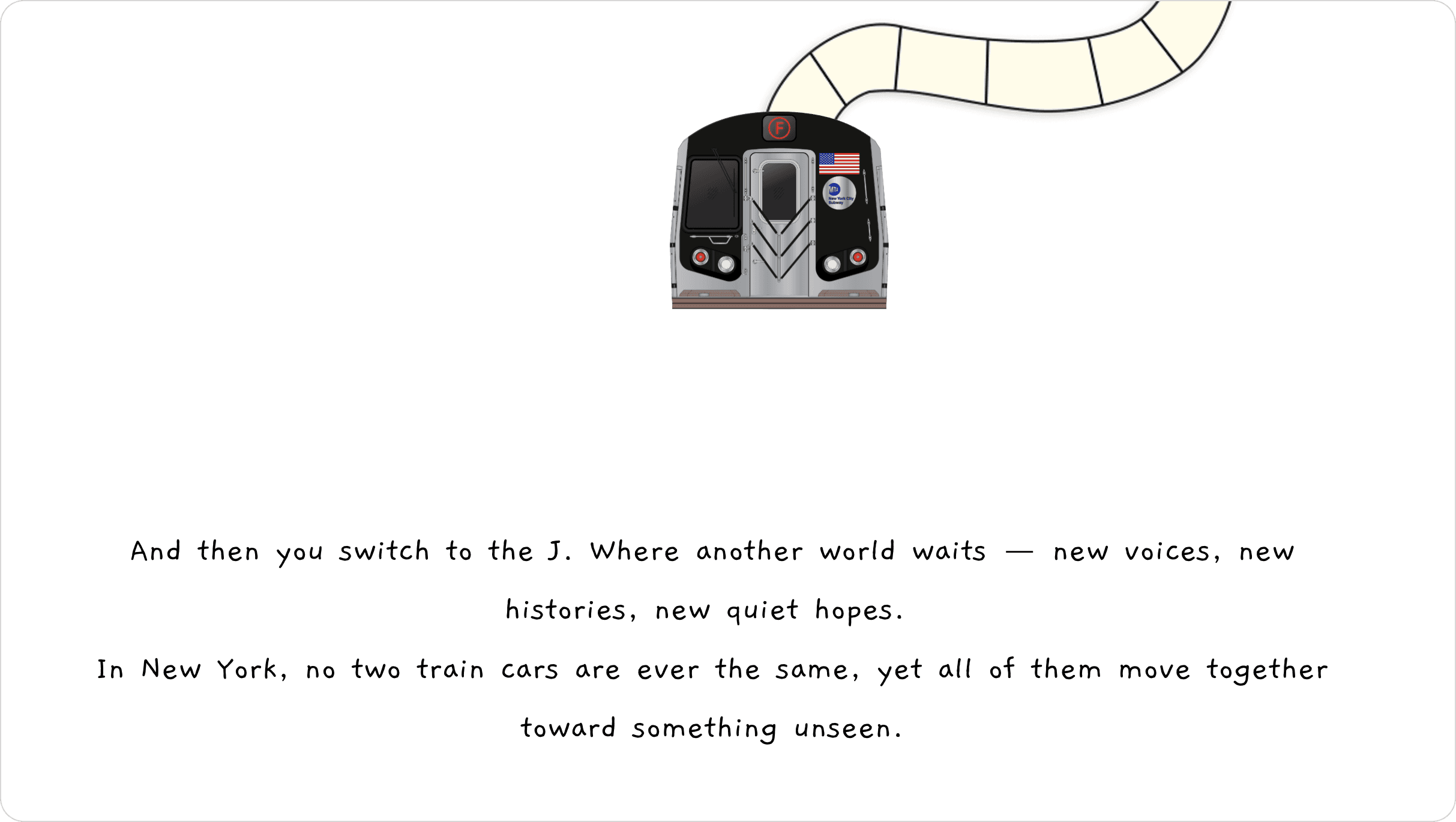
People of New York: A whimsical ride on the F-train
OVERVIEW
Inspired by Humans of New York, People of New York explores how everyday, anonymous encounters can be transformed into moments of quiet narrative recognition.
Set inside a moving NYC subway car, the story unfolds through scroll-based interaction. As the train travels from station to station, new people enter the car. Each character arrives with a short backstory, revealing a fragment of their life before the train continues on its route.
The experience is intentionally incomplete. Stories are introduced, not resolved, mirroring how we encounter people in real life.
HOW DID I END UP HERE?
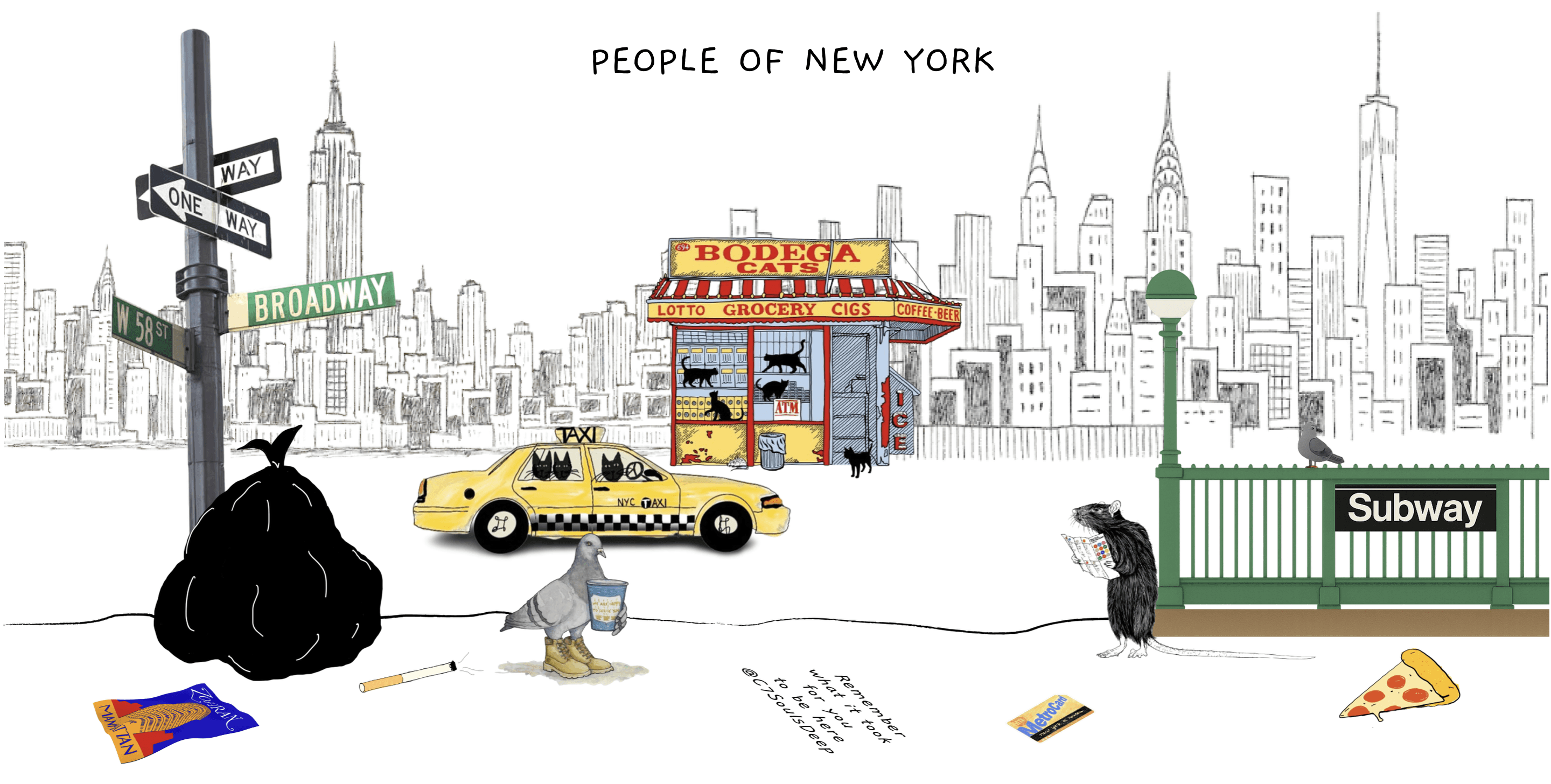
Location played a foundational role in shaping this story. New York City felt like the natural setting, an ode to the past year and a city I’ve come to know closely.
The original direction would have guided the reader through various neighborhoods in New York City. I planned to draw from real unsolved mysteries and translate them into a game-board-style narrative across Manhattan, using the city’s clearly defined neighborhoods to shape the tone of each section
VISUAL INSPIRATION
While I was still searching for a good story, I began my search for the visuals for a digital gameboard
During this search phase, I stumbled upon the react.gg website — and was immediately impressed by the page's visual. Especially the board-game-like track. A minute into staring at the design — my brain immediately thought of train tracks
FINAL IDEA
What if I take readers through a train journey and give them multiple stories and not just one.
That's when it hit me — why would I do one story when I could share multiple short stories. Stories that capture the essence of how everyone lives a unique and different life.
NARRATIVE INTENTION
We spend hours of our lives surrounded by strangers, knowing nothing about them.
This simple observation provided direction to the storyline. Rather than inventing dramatic arcs or climactic moments, the goal was to design a narrative that:
Centers on fleeting human presence
Respects the anonymity of urban life
Finds meaning in brief, ordinary moments
The subway was chosen because it naturally holds tension between proximity and distance. People share space, movement, and time, without sharing their stories.
NARRATIVE STRUCTURE
The story follows a cyclical structure instead of a linear arc.
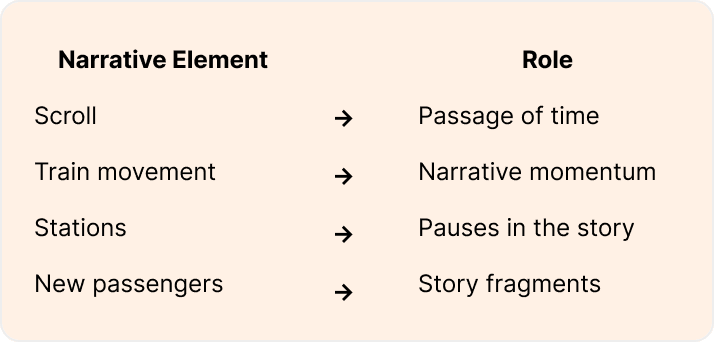
Each station acts as a narrative beat. A character enters, is briefly introduced, and remains present as the story moves forward.
There is no resolution because the story is not about outcomes. It is about coexistence.
Voice & Tone
The narrative voice shifts intentionally at the beginning of the experience.
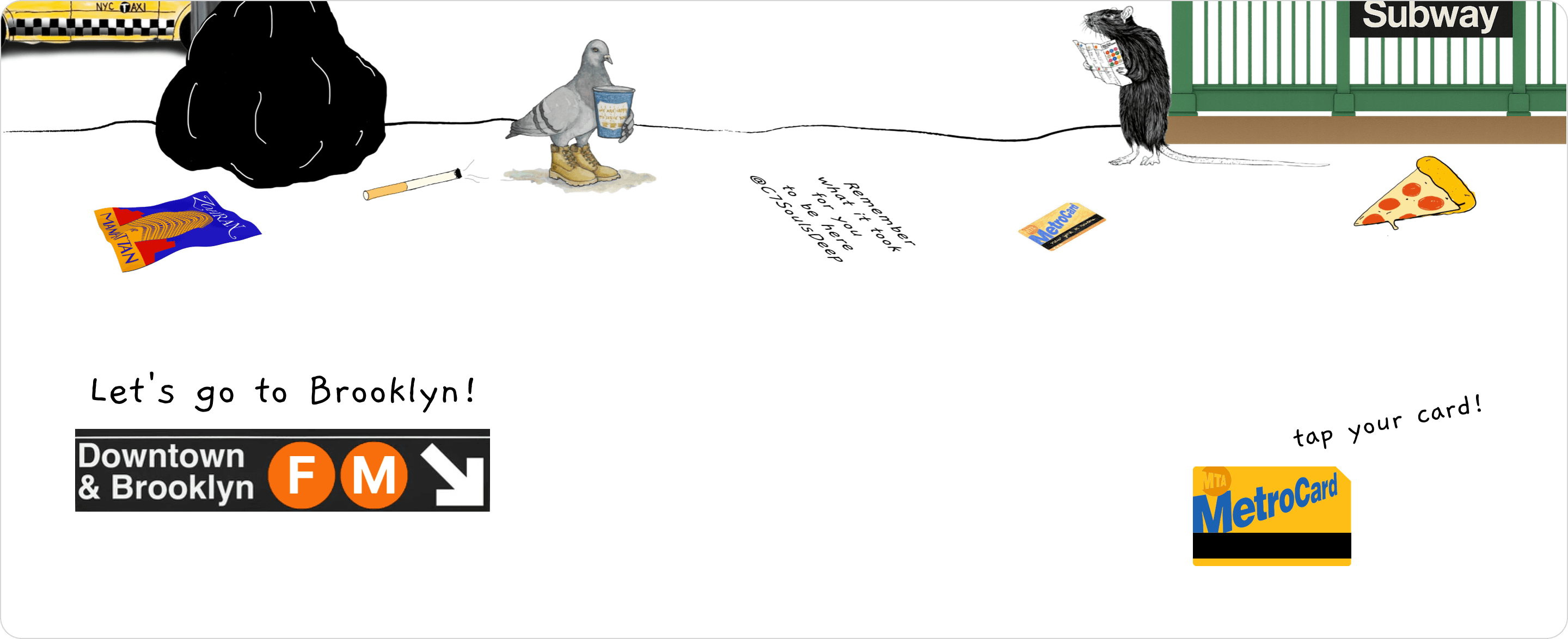
The opening line — “Let’s go to Brooklyn. Tap your card.” — directly addresses the reader, inviting them into the story through a familiar New York gesture. This moment functions as an entry point rather than sustained narration, grounding the experience in action and place.
Once the journey begins, the voice pulls back.
The remainder of the story adopts a restrained, observational tone:
Third-person perspective
No ongoing direct address
No internal monologues
This contrast mirrors the subway experience itself, an active choice to enter, followed by passive observation. The brief use of direct address establishes immersion, while the consistent observational voice allows the characters and environment to speak for themselves.
Character Construction
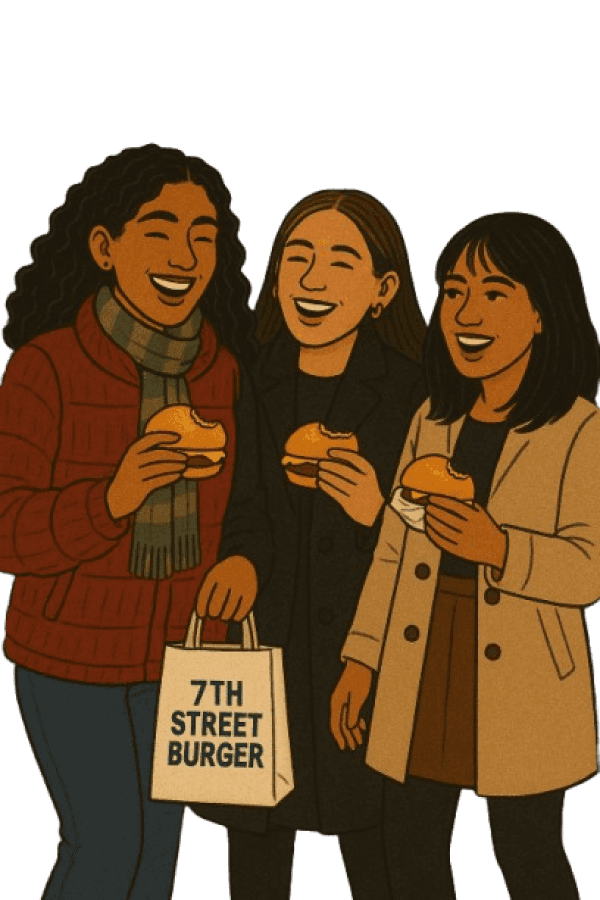
Characters are intentionally underwritten.
Each person is defined through:
A visual cue (clothing, object, posture)
A single situational context
A moment in their day, not their entire life
This approach resists:
Over-explanation
Backstory overload
Emotional manipulation
Instead, it allows readers to fill in the gaps themselves, making the narrative participatory through imagination rather than choice.
Sound as Storytelling
Audio plays a key role in creating an immersive experience within the story.
Sound is used as a narrative cue rather than background atmosphere. The experience opens with the reader tapping the metrocard, which triggers the audio — “stand clear of the closing doors”. As the reader goes through the stops the station chime plays when the train doors open— signals transitions between moments.
Why Scrollytelling?
Characters are intentionally underwritten.
Scrolling was chosen as the storytelling mechanic because it mirrors the physical act of travel.
The reader cannot skip ahead meaningfully, just as one cannot rush a subway ride.
The pace is controlled but flexible.
Motion replaces exposition.
This transforms scrolling from a functional action into a narrative gesture.
Ending Without Closure
The experience concludes with a transition rather than a resolution.
By ending this way, the narrative resists closure and instead gestures toward the countless stories still unfolding beyond the frame. The reader exits the experience not with answers, but with the sense that the city — and its people — continue moving, whether observed or not.
References & Credits
Character Images:
Character images were generated using ChatGPT and curated specifically for this project.
Illustrations & Visual References:
Some illustrative references were sourced from Pinterest. Due to the nature of the platform, the original creators could not be consistently identified. These images were used for educational and exploratory purposes only.
Editorial Illustration Reference:
The illustration of the rat with the subway guide is sourced from The New York Times.
This project was created for academic purposes and is not intended for commercial use.